One page a day, answers at the back.
Tables, mental methods and written methods, drilled in that order. This page says what is on a page, how many questions it holds, why the key is where it is, and how long the set will last at the pace you choose.
What is drilled, and in what order
Tables, then mental methods, then written methods. Each drilled on its own, then mixed with what came before it, never with what comes after.
The number books run in one direction: from what you can hold in your head to what you need paper for. Nothing later in a book depends on something that comes after it, and nothing early is skipped because it looks easy. The order is the point.
FirstTables
Addition and subtraction facts to twenty, then the multiplication tables to twelve, one table at a time and then mixed. A page of tables is a page of questions with the table itself printed nowhere on it. You either know the fact or you look it up at the back, and looking it up is fine: that is what the back is for.
SecondMental methods
Adding near a ten, doubling and halving, taking a number apart and putting it back together, multiplying by ten and by a hundred, and the handful of tricks that make a shop total or a length of timber quick to add up. Each method gets a page of its own, then two mixed pages, so it is met on its own before it is met with the others.
ThirdWritten methods
Column addition and subtraction, long multiplication, short and long division, and fractions and decimals worked on paper with the working shown. The pages are ruled in small squares so the columns line up, because half the errors in written arithmetic are columns that slipped.
The three sections are sold as one book at each of four levels, or the sections can be bought as separate thinner books if only one is wanted. The order form has a line for each.
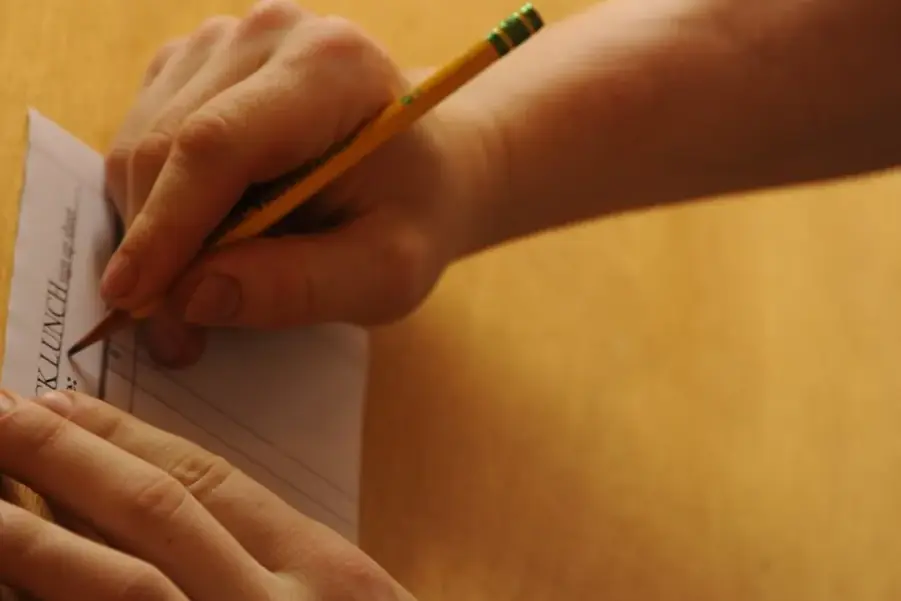
The page: how many questions, and why the answers are at the back
Forty, twenty-four or eight questions to a page, depending on the section. Never a page you cannot finish at one sitting.
A tables page carries forty questions in four columns of ten. A mental-methods page carries twenty-four, in two columns, because each needs a moment more thought. A written-methods page carries eight, with a ruled working space under each. Those numbers do not change through a book, so a page is always the same size of task and you always know what you are sitting down to.
The answers sit at the back of the book, in the same order as the pages, with the page number beside each set. They are not printed upside down at the foot of the page and they are not on the facing page. The reason is simple. An answer that can be seen gets looked at, not always on purpose, and a page that has been half-read is not practice. Turning to the back is an act. You do it after the page, or when you are honestly stuck, and either way you know you have done it.
The answer key gives the answer only. For the written-methods section it also shows one worked line for any question where the method matters more than the result, so you can see where a slip happened rather than just that it happened.
How long a page takes, and how long a book lasts
Type what you are planning and the sum below tells you how many sittings the set holds. It is the only number on this site that is ours to give.
A page is sized to take about a quarter of an hour at a steady pace. Some take longer. Nothing is timed, and there is no clock printed anywhere in the book, because a race is a different exercise from a drill and we are only selling the drill. If a page takes twice as long as the last one, that is information about the page, not a mark against you.
One page a day is the pace the books are written for. Two pages a day is fine if they are from the same section. Skipping days is fine. What does not work is a whole section in an afternoon, because the mixed pages assume the earlier ones had a night's sleep between them.
The figure above is arithmetic on what you typed, nothing more. It says how many pages there are and how many sittings that is. It does not say what you will know at the end, because a book cannot know that.